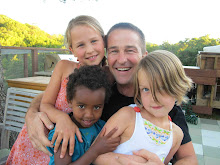
We bought an IPad a couple weeks ago and it has been a hot commodity. Mihiretu plays Angry Birds, Mae plays Spellcraft and Lana, it turns out, uses it for a purpose all her own.
She asked for the IPad last night before she went to bed. Much later, after Ben had tucked her in, he brought it to bed with him. While I read my novels, he surfs craigslist for strange and varied vehicles (“Look, honey, at this old school bus!” or “That’s a cool pick-up” or “Nobody wants the big Airstreams”). This has long been his favorite pastime, first with the computer, then with his IPhone and now, hallelujah, with an IPad. He’s come a long way, baby.
As he turned on the IPad, he saw several videos on the desktop, all of Lana’s face.
There is a Justin Bieber imitation. She’s not a fan – I don’t believe she’s ever even seen a video – but Justin Bieber is this year’s Miley Cyrus so the second graders are all atwitter. In these she’s naked from the waist up (her favorite outfit, really, and what she deemed most Bieberesque). She speaks as if she has a heavy cold, her accent is vaguely Southern. Her hair is swept across her forehead in a cunning imitation of his famous locks.
She says, “Hi, I’m Justin Biebah and I’m gonna SING for ya. But first I have a few words to say.” Here she brings her hands in front of her face in desperate upturned claws, her face contorts with pain and she moans “Nevah say NEVAH!” She drops her hands, relaxes her face, sweeps her hair across her forehead and says, matter-of-factly, “And I just said ‘never” so I should go to jail shouldn’t I? Well, first I’m gonna sing my song and then I’m gonna march to jail.”
Then, nostrils flaring, she sings tunelessly, expressively, “Oh, this is my song. It’s my best one so far.” And it goes from there, something about “I’ve got a chicken and I’m saying HEY!”
My favorite video, I think, is an extreme close-up. She says, very simply, by way of introduction, “I am a girl but I have a very funny name. You will hear it in this song many times. Heeeeere we go.” Her brows draw together, her eyes widen and her voice deepens as she sings, “Bob, Bob, Bob, that is my name. Robert, but Bob for short. Bob, Bob, Bob, that is my name but” here she pans out to a wide shot and her voice raises three octaves “I am a GIRL!”
The best thing about these videos is that she is alone. She has no audience beyond herself and so what we see is very pure. Purely goofy, yes, but here I have evidence of the essential Lana.
The world sees a blond, blue-eyed child, generally quiet in public, seeming particularly so in contrast to a brother who is always either racing, jumping, climbing, teasing or screaming. Acquaintances, until they truly know her, imagine her as docile. In fact, she is possibly the strongest personality of the bunch – and that’s saying something, given the bunch. She is publicly reserved and privately outrageous. She is my secret extrovert while Mae, who strikes the world as bold, is my secret introvert. Mihiretu, of course, is no secret.
I will treasure this bit of – what is it? video? bytes? IPad magic?. Whatever it is, I will hold it close so I can remember this covertly wild girl, this angel with the devilish sense of humor.
Thursday, January 26, 2012


Friday, January 6, 2012
Same Shit
I wrote a piece about our trip to the snow, or rather our trip to the “snow” as it’s the driest winter Tahoe has seen in recorded history (you were so right, Al Gore), but my essay got erased. Twice. That’s what you get for having children up your nether-regions – and all over your computer with their sticky little fingers – during the “holidays”. I don’t know who was having a holiday but it certainly wasn’t me.
Here’s the “snow” in a nutshell: one of our party (I won’t say who) subjecting the rest to highly stinky HAFE (high-altitude flatulence explosions, an actual medical ailment, look it up), two different Caprons simultaneously slipping on ice and peeing their pants (I won’t say who), sleeping - or should I say “sleeping” - in five bunks stacked on a wall with children crawling through the beds like a Habitrail at four a.m., Mae violently struck with altitude sickness when we took the tram to the top of Squaw (migraine aura followed by terrible headache followed by vomiting) while Mihiretu and Lana ice-skated with walker-like contraptions, like drunk eighty-year-old hooligans. And, of course, all the discomfort and hassle was worth it with one glimpse of our three children bundled like Michelin Men pulling a red plastic sled up a small hill of icy, muddy snow. That’s pretty much the long and the short of it. Can I call it done now?
In other news, we gave Mae her own room a week ago. Our office is now her lair. My desk is now in the sunny livingroom, one friend’s painting and another friend’s shadow box arranged above it. I’ve given up a room of one’s own but I like my new little space and Mae certainly likes hers. She has escaped her brother and landed in a pre-teen haven, her own private Idaho.
Last night Ben and I listened as Mae sang herself to sleep. “The flower said I wish I was a tree,” she warbled. “The tree said I wish that I could be a different kind of tree. The cat wished that it was a bee. The turtle wished that it could fly really high into the sky over rooftops and then dive deep into the sea.”
It was lovely, her singing. Not that she’s particularly gifted musically but her desire and ability to do it for herself was beautiful. She didn’t know we were listening. This was raising her voice in song for the love of it, for the love of herself.
When she moved on to a different song on the same Kimya Dawson album, a nice little number entitled “Same Shit”, it was clear it was time to pull the plug.
“Go to sleep, Mae,” Ben called.
“Day after day after day, it’s the same shit. Day after day after day, it’s the same shit. Day after day after day, it’s the same shit.”
“Mae!” Ben and I called together.
There was silence and then quietly, happily, “Day after day after day after day after day.”
Sunday, December 11, 2011
11/11/11
Where do I begin?
My mother died on my son's birthday. We were at the House of Air, an upscale reclaimed warehouse turned trampoline palace - very San Franciso. I had taken two hours away from my vigil at my mother's bedside. "You've got a few days" said the hospice nurse. "Nothing is going to happen today" said the social worker. And so Ben and I had loaded six five-year-old boys, two extra daughters, and assorted cupcakes into the mini-van and headed for the city.
It was Veteran's Day and the place was packed to the rafters with shrieking, bouncing children and sleek, slightly flustered, urban mothers. Ben and I, with the aid of his sister Anne, managed to peel off coats and shoes, stow cupcakes and throw small boys onto the vast field of trampolines. I was checking on the pizza delivery when my phone rang.
It was the nurse. I ran through the throng like a quarterback at the Super Bowl to get outside where I could hear her. She was with my mom. My mom was gasping for breath. She was revising her previous assessment. Hours, not days.
Stunned, I hung up and went to find Ben. "Go," he said. "You need to go."
I was finding my shoes and instructing Ben about pizza, cupcakes and gifts when the phone rang again.
"Hold on," I said, running for the door. I could hear someone saying something. The only word I could make out, repeated many times, was "sorry".
Finally I burst into the wet November air.
"I'm sorry," I heard the nurse say. "Your mother just died."
I stood in front of the House of Air, leaning against the giant warehouse windows.
"Oh," I said.
I had envisaged this moment since my mom's Alzheimer's diagnosis years ago. Where would I be when I heard? What would I feel about a death that meant the end of her agony? Would I cry?
Turns out I would. I hung up the phone and stood in the rain, fashionable young parents skirting around me, shepherding children who were turning to stare.
After much maneuvering, Ben and I managed to leave the party in Anne's hands with another Ann, our friend, on her way to help.
I cried all the way from the Presidio to the house in Corte Madera, one of the most beautiful drives there is. I sobbed across the Golden Gate Bridge, through the Headlands, down Waldo Grade with it's picture perfect view of Mount Tam.
We walked into my mother's room. It was empty but for her. Hardly able to breathe for crying, I put one hand on her arm and the other, in the pose of universal grief, over my eyes. She was still warm.
Ben brought me a chair and I sat for two hours, crying like I've never cried before and hope to never cry again, taking my hand from her body only to wipe my face of tears and blow my nose. When I'd touch her again, she would feel the slightest bit colder, which renewed the shower of tears every time.
My mother looked beautiful. She was always an attractive woman but somehow, during these last years, as her body has shrunk, the bones of her face have become prominent again. She looked, as she lay there, like the girl she once was in the picture on the dresser. She looked like her essential self.
The tears finally dried. We left, one last look over my shoulder at this woman who had meant so much. I walked back out into a changed world, a world that is empty of her. I'm still, a month later, trying to reconcile this strange place, this place where I do all the same things - make groceries lists, walk children to school, read novels, make jokes - with the one that was before. Only when I'm sleeping do I feel right. In that dreamworld where everything is strange, where nothing makes sense, that's where I feel at home. There I float with my mother, with my father, in the space between this plane and the next.
Wednesday, November 30, 2011
Eulogy
This is what I know about my mother.
I know that she was born to Romanian immigrants in Depression-Era Detroit. I know that her family lived for a time from the garden her father grew behind their house. I know that her beautiful and mythical mother, Valeria, from whom I got my middle name, died of pneumonia when my mother was two. I know that my grandfather, by all accounts a warm and loving man, sent his three children to live in an orphanage while he pulled himself together. I know that my mother’s brothers were housed in one part of the orphanage, the boys’ section, and that she, a toddler, was on her own with the girls, bereft and confused. I know that my grandfather remarried, a woman called Stella, whose very name sent shivers down my mother’s spine for the rest of her life. I know that Stella was abusive, particularly to my mother. I know that all this difficulty, all this loss and loneliness and pain, was impossible for her to set down. She carried it with her through the rest of her days.
I know that my parents met on a beach in Miami. My mother was on vacation. My father was in the Air Force. She was twenty-three, he was twenty-one. I imagine them in their bathing suits though I don’t know it to be fact. They were married six weeks later. The power of bathing suits.
I know that they lived in post-war Germany for two periods, one right after their marriage and the other when my brother and sister were small. I know that for both of them, raised without much means, living in Europe seemed impossibly, deliciously sophisticated.
I know that my mother worked as a secretary to support the family as my father went through college and medical school. I know they moved a lot as my father went from the Air Force to undergrad to medical school to residency. Fabled names for me as I didn’t yet exist – Dover, Chumsford, Boulder, Philadelphia.
I know that after decades of being on the move, they finally came to rest in Marin County. I know that, much to my father’s surprise, but apparently not to my mother’s, I was born, a late baby, at least for those days. My mother was thirty-nine, a woman who was raised without a mother but with twelve years of parenting under her belt – a pro.
I know that she stayed home with me for the first eight years of my life. I remember that time as cushioned in fog – we lived on Mount Tam – her warm hand in mine, answering every question I could pose to the best of her ability. Did she love me better or Casey across the street? Did she believe in God? How did the robin make those eggs in that nest? I know that hers was the most beautiful face I could imagine.
By the time I was born, the family had hit some calm waters, financially, geographically. My siblings were half-grown. She had some time, some ease. She seemed forever interested in my small life, my meandering thoughts. She called me her little friend. She told me I was so smart and so kind. She made it so.
She returned to work when I was eight, running my father’s medical office. I grew up and away. Together we weathered my father’s early death, and ten years or so later, the onset of her dementia.
I know all that, what came before my birth and after my childhood, but what I really know of my mother I know from when I was little. I know that she was perhaps the kindest person I’ve ever met. I know that she was funny, that she had a beautiful delighted laugh, that shy as she was, not everyone heard. I know that she loved her family - her children, her husband - more than life itself.
I know that she, a motherless child, taught me how to be a mother by nurturing me so well, so thoroughly. I know that I speak her words every day to my kids. Treat others the way you want to be treated. What do you think? Tell me about your day. Nice outfit! That book is so good, isn’t it? You are so smart. I love you more than I can say.
This is what I know about my mother. I know that she weathered such heartbreak so young, such difficulty throughout her life, really, raising children on the fly, struggling to make ends meet, losing her husband before his time, watching her world close in with Alzheimers. She had all that inflicted upon her and yet she remained open, so sweet, so willing to unfold her heart, to engage.
This, in the end, is what I know about my mother. I’ll always hear her encouraging voice in my head. I’ll miss her for the rest of my days. I love her more than I can say.
Wednesday, November 9, 2011
Waiting
Last Saturday, my mother's already tremulous health took a dip. Her eating and drinking, lately on the wane, has stopped. She sleeps unless interrupted by caregivers, nurses or doctors. When someone does try to change her clothing or take her blood-pressure, my mom has three slurred words for them, dictated, eyes closed, through clenched teeth. They are "Leave me alone." Sometimes, though less now, if she's feeling feisty it's five words. "Leave me the hell alone." One time she told the doctor that she - the doctor - was full of shit. The doctor agreed that she - my mother - was probably accurate.
The time has come to leave my mom alone. No more terrifying emergency room visits, my mother screaming, convinced that every unknown staff member is trying to kill her. No more medication beyond what's needed to keep her comfortable. It's time that she's released.
For the last few days I've been sitting at my mom's bedside. I've got Puccini playing on my Iphone, a jasmine candle burning (which I try to hide when the caregivers come in - who knows if it's allowed), my Big Crazy sweater wrapped around me, my book in my lap and my hand on my moms'. When she flinches in her sleep or - and this is rare - opens her unfocused eyes, I tell her I love her, that she's okay.
When I was a kid, I decided that my favorite thing to do with my mom was to wait. When the car broke down and we had to sit at the repair shop for hours, I was happy as a clam. I had my busy and distracted mother pinned to a space and time. She had no choice but to talk with me, to play with me, to laugh with me. Waiting, I decided, was really the only time I could get her full attention.
I'm now waiting again with my mom. But instead of her being the busy and distracted one, it's me. I've been forced - okay I've chosen - to drop everything and be in that room with her. I tell her stories of when we were young together; when she showed me the bird-nest on our porch complete with small blue eggs and gave a fumbled birds-and-the-bees talk, when we went to Tahoe in the summer and read and ate junk food and stayed up late, when she would tell me I was her little friend. I tell her that it's okay to go now. That Pop will be waiting for her. And her father. And her mother, who she lost when she was so small. The world waits outside, still spinning, still busy. We wait inside, in a stilled moment, breathing in and breathing out, me and my mama, together for a few more days, me memorizing her face, her lost in a dream.
Saturday, October 29, 2011
Big Crazy
A few days ago, I was struck with an unfamiliar sensation. I was driving home from the gym, mentally mapping out my morning - the shower, the groceries, laundry, lunch, picking up the kids. This practice, even this plan, was not unusual. What was strange was the energy with which I contemplated it. For the first time in two months, I wasn't viewing what was in front of me from the smoldering pit of anxiety and depression. Indeed, I was anticipating my day with relish.
I've had many moments of laughter, of silliness, of fun, even, in the last long months of depression, but I haven't, for what seems like an eternity, felt okay. Always there has been the nagging feeling that things are not all right, really not all right, that at any time, everything could fall apart - from the world to my family to just my own mind. In the last few days, that feeling, for hours at a time, has ebbed.
Two weeks ago, my new psychiatrist, after much gathering of history and weighing pros and cons, put me on a new medication. My family history, even my own, is complicated. There are shades of bipolar right and left as well as touches of OCD to add to the general palette of major depression and anxiety. Finding the right drug for me was challenging. Some work for depression and anxiety but aggravate bipolar and OCD tendencies. Others manage bipolar symptoms but don't do much for the rest of it. And some, god forbid, cause weight-gain, an absolute deal-breaker in my book. That alone would make me depressed and anxious.
And so finally we reached a compromise, a drug that could, hopefully, quell the symptoms that bother me most without precipitating a mania (something I've only tasted but have witnessed full bloom in my mother). I took the pill and I waited. Days went by, some better, some worse. Anxiety would hit and and I would be anxious that it was back. Depression would take hold and it would make me depressed. I have been trying to pull myself out of these self-perpetuating whirlpools for so long now.
And then, for a number of days, I've felt well. Not manic, not speedy, not hyper-joyful but well. I have energy for something other than trying desperately to feel okay. A couple days ago I cobbled together a sweater-coat out of recycled cashmere sweaters. It's comprised of four sweaters, big patches and small, purple and brown and green argyle. It is a big garment; it reaches past my knees, I can wrap it around me to create a nest of layers of soft wool. Ben has termed it "Big Crazy". I was working on at our weekly stitch-and-bitch and when I was polling my girlfriends about how I should patch a moth-hole on the back, my friend, Ann, suggested the letters "LC" as in Liz Capron. I've been half-heartedly searching for a new nickname because there are suddenly so many Lizs in our parental sphere. There followed a discussion where I referred to myself in the third person as we laughed about how LC rolls. LC is tough, it seems, and decisive; she tells it like it is. And maybe, well, a little out there. A little crazy.
There's something about this article of clothing that speaks of this whole experience. I took apart something that wasn't working - old sweaters in one case and my mental health in the other - and pieced it back together into something that is strange but beautiful and very me. It's a giant, wearable, baby-soft blanket, a form of comfort I've created for myself. This depression has been different than the others in that I've been very public about what I've been going through. I have refused to hide. I've taken what's wrong and I've worn it and made it right. With a big "LC" emblazoned on my back, an emblem of the new me that has emerged.
Thursday, October 13, 2011
Little Criminals
I have a general afternoon conundrum. The girls have homework and could use downtime at home. Mihiretu is, quite simply, awful indoors. By nature, he should be running, yelling, throwing balls. Those things don't work so well in our living-room. Particularly when his sisters are otherwise occupied. In an effort to focus all attention forever on him, he steals spelling lists, maims multiplication tables, chucks super-balls at their heads.
In an effort to have our afternoons be all things to all Caprons, I decided to try a round-robin play-date. Every Wednesday, each child has a standing date with a friend. Locations alternate week to week. Yesterday, Lana was at her friend, Ella's. Mae's pal, Ryder, was over here. Mihiretu had Luke here, too.
I've discussed Luke in these pages before. He's a kid very much like my son; handsome, busy, charming, rascally. The two boys match each other's energy - a phenomenon fortunate or catastrophic, depending on the day.
Yesterday, I urged the boys to play outside while the girls designed Ryder's Halloween costume. The girls sat, shiny brown head to shiny brown head, absently chomping pear while they studied their drawing, wondering just what a snow bride would wear. Snow bride? Snow bride.
The boys, meanwhile, circled the house, waving sticks at each other and the occasional passing buck. I would hand a banana or a bottle of water out the front door from time to time but mostly let them be. The lunch dishes were washed and dinner was underway when Mihiretu burst in the front door.
"Luke!" he said, gasping for breath. "Play pano! 'Tole money!"
Luke skidded in behind him. "It was Mihiretu's idea!" he shouted. "He's the one that played the piano!"
Slowly I gathered that the boys had entered the apartment downstairs, the apartment we rent out, the apartment for which we have a signed agreement not to enter without 48 hours notice.
"You played their piano?" I asked, my eyebrows reaching for my hairline, "You stole MONEY?"
Each boy pointed at the other. I ran outside and down the stairs. Indeed, the apartment door was open. Oh my god.
Unable to find evidence of stolen money (for Mihiretu a penny is big money so it could have been minor) and otherwise assessing our tenant's home to be intact, I eased the door closed and pulled them back upstairs.
Admonished and re-bananaed, they headed off again.
By now the costume design was done. I looked it over, made a few suggestions and got to work on a pattern. As we cut shiny blue fabric, stitched and fit Ryder, the boys came in intermittently. Each time, I hustled them back outside. If you don't want Mihiretu inside on a sunny afternoon, you REALLY don't want Mihiretu and Luke together penned by walls and delicate furniture.
Soon I sent the girls outside to occupy the boys while I finished the dress. Within a moment, they were back, breathless.
"They're on the neighbor's roof!" Mae gasped.
I ran out onto the back deck and, following the arc of Mae's accusatory finger, saw two boys, one blond, one curly brunet, balanced below on the Mexican tiled roof of the house downslope.
"Off the roof!" I screamed, my voice cracking. The boys glanced in my direction but continued in their investigation, prying tiles, poking under with their sticks.
"You guys!" I shrieked. "OFF THE ROOF!"
Moments later, thoroughly hoarse, I had successfully cajoled the boys back up the hill. Why does counting work when all else fails?
The boys now strictly instructed to stay off and out of other people's property, I, perhaps foolishly, headed back inside to finish up Ryder's costume. The girls started a game of soccer with the boys.
Soon it was five o'clock, the dress was done, dinner was bubbling on the stove and Kelsey, Luke's mom, was walking through the door. Together we collected Luke and his back-pack, socks and shoes as I told her of the afternoon high-jinks. All of us walked down to say good-bye at the car.
Luke was secured in his car-seat and we were saying our farewells when Mae and Ryder shouted from the other side of our van for us to come. I peeked around the back and burst out laughing.
"Kelsey," I said, "You have to see this."
There, against the side of our van, stood a two-foot round boulder, clearly pushed down the hill by the boys. There was a scratch in the paint but no dent. Kelsey and I shook our heads.
As they drove away, I felt strangely buoyed, curious given this afternoon of boulder-rolling, roof climbing and breaking and entering. Instead of worrying for Mihiretu's future, the jail cell he and Luke would share in fifteen years, I took a deep breath and hefted a sigh of relief that there is a boy out there as crazy as my son. A boy who was not orphaned, not adopted, not transplanted half way around the world. A boy who is active, curious and sometimes bombastic. Just like my son. Boys are, apparently, boys. As the mother of a boy, a testerone-addled, adorable maniac, I do not stand alone.
Subscribe to:
Posts (Atom)